WORTHINGTON CHARTER AMENDMENTS: ISSUES 35,36,37,38
Issue 35
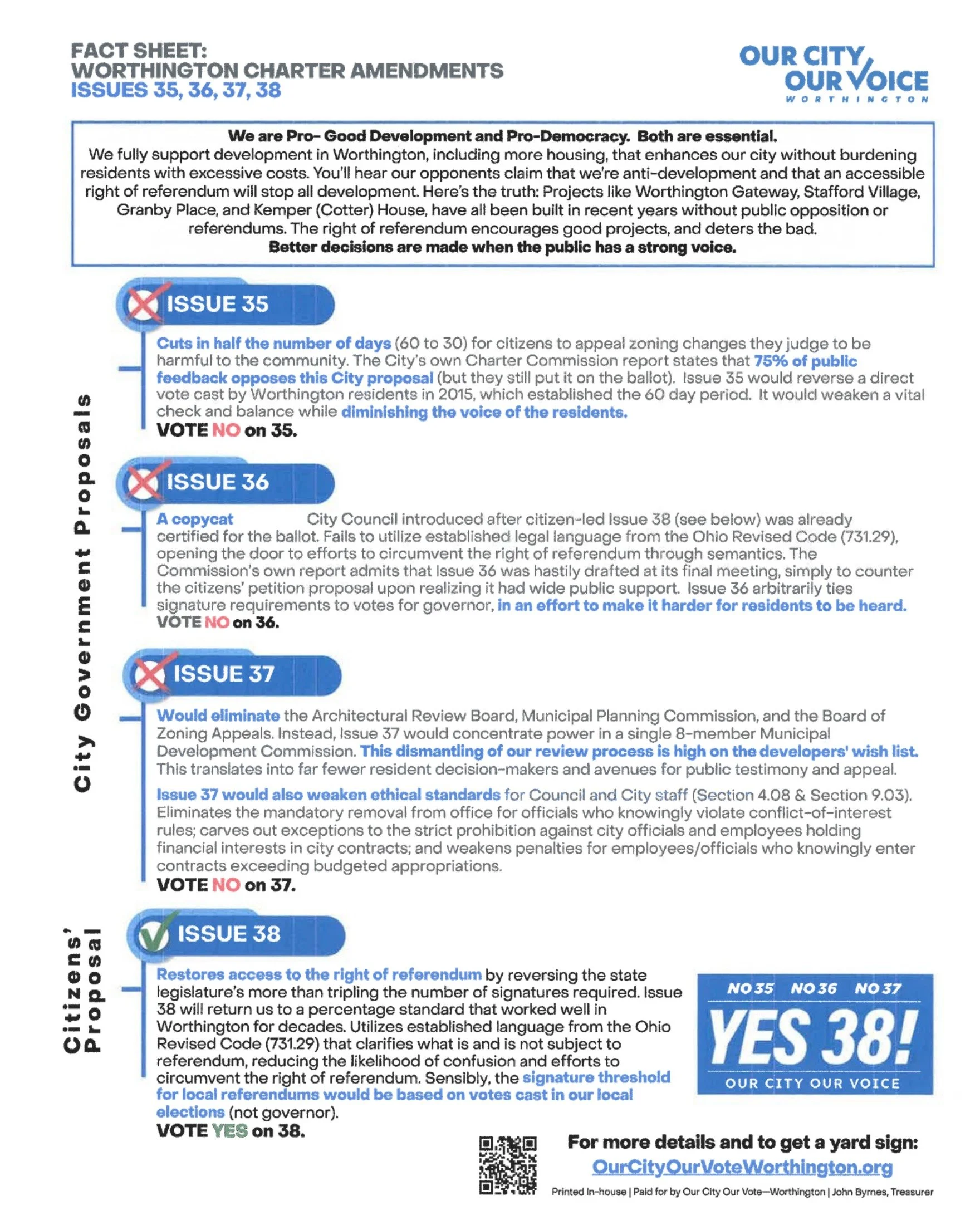
• Claim: Issue 35 would reverse a direct vote cast by Worthington residents in 2015, which established the 60 day period. It would weaken a vital check and balance while diminishing the voice of the residents.
• Response: Keep Worthington Beautiful was approved in 2015 by a narrow margin of 253 votes, with 3,167 votes (52%) in favor and 2,914 (48%) opposed. Ten years later, the electorate participating in Worthington elections looks considerably different. Of the 6,503 people who voted in 2025, 2,872 did not participate in the 2015 election. In other words, nearly 44% of those voting in 2025 were not among the voters who decided the original measure. Revisiting a Charter provision ten years later gives today's electorate an opportunity to decide whether that provision still strikes the right balance for Worthington.
State law provides a 30-day petition period, as do 13 out of 16 Central Ohio communities reviewed. Petitioners in Worthington have recently demonstrated that collecting the required signatures within 30 days is achievable.
Issue 36
• Claim: Issue 36 is a copycat measure, an attempt to counter the citizen’s petition, and an effort to make it harder for residents to be heard
• Response: Our City Our Voice (authors of Issue 38) submitted their petition separately from the Charter Review Process and included language that went beyond simply restoring the previous 10% threshold. Issue 36 could have been avoided altogether if the petitioners had submitted language that simply changed the number of signatures required to 10% of the votes cast in the last gubernatorial election, actually restoring the threshold Worthington had previously used, while leaving the existing referendum language regarding zoning measures unchanged.
Issue 37
• Claim: The consolidation of the ARB, MPC and BZA into a single Municipal Development Commission is high on the developers’ wish list and would translate into far fewer resident decision-makers and avenues for public testimony and appeal.
• Response: There are also benefits to residents from the consolidation. First, over 80% of the applications received by these three boards are initiated by residents with home additions or outdoor structures. Second, having a single development commission would provide a clearer and more predictable process for residents to understand where to provide public testimony. The consolidation itself does not eliminate the public notice requirements that apply before ordinances or other approvals take effect.
Issue 38
• Claim: Restores access to the right of referendum, by returning us to a percentage standard that worked well in Worthington for decades. Utilizes established language from the ORC (731.29) that clarifies what is subject to referendum, reducing the likelihood of confusion and efforts to circumvent the right of referendum.
• Response: The right of referendum still exists today and is preserved through Issues 35 and 36. Issue 38 reduces the number of signatures needed for referendum by changing the basis from votes cast in the last gubernatorial election to turnout in the last municipal election. This approach is uncommon among the Central Ohio communities reviewed, most of which rely on state law or gubernatorial-election turnout.
Issue 38 also changes what may be subject to referendum. It adds language giving the power of referendum over “any ordinance or other measure passed by Council,” preceded by the phrase “notwithstanding any other provision of this Charter,” while removing the existing reference to measures “amending the City’s zoning code.” Rather than clarifying what is subject to referendum, these changes are what create the confusion because it is unclear which Council decisions would now be subject to referendum. That uncertainty could lead to disputes, delays and potentially litigation over what the amendment means. Read local attorney opinion here.
Charter Review Commission
• Claim: The Charter Review Commission made recommendations that are not backed by evidence and are in opposition to the public comments received.
• Response: The Charter Review Commission held six public meetings with extensive deliberation on the Charter. Its role was to consider provisions that had been active topics of community discussion and recommend changes where it believed a better balance could be achieved among the different priorities facing the community. Making recommendations on those issues was precisely the role of the Commission, and ultimately, Worthington voters have the final say on any Charter amendment.
The Commission also separated its recommendations into three ballot issues so potentially controversial changes could be considered individually, providing greater transparency and reducing confusion by allowing voters to consider each issue on its own merits.
“Good Development” and “Pro-Democracy”
• Claim: We are Pro-Good Development and Pro-Democracy. Both are essential.
• Response: The phrase “Good Development” is subjective because what constitutes “good” depends on the priorities being considered. Development decisions require balancing many priorities and perspectives. That includes public input, neighborhood and traffic concerns, but also offset by housing needs, property rights, professional planning recommendations and the City’s economic development goals. When decisions become too dependent on subjective standards, the process becomes less predictable and consistent for residents, property owners and developers.
Likewise, “Pro-Democracy” can mean different things in this context. Democracy includes both direct participation through referendum and representative democracy through the elected officials voters choose to make decisions on their behalf.
Development and Housing
• Claim: We fully support development in Worthington, including more housing, that enhances our city without burdening residents with excessive costs. You’ll hear our opponents claim that we’re anti-development and that an accessible right of referendum will stop all development. Here’s the truth: Projects like Worthington Gateway, Stafford Village, Granby Place, and Kemper (Cotter) House, have all been built in recent years without public opposition or Referendums.
• Response: The phrase “enhances our city” is also subjective and does not define what types of housing or development best serve the community as a whole. Likewise, “without burdening residents with excessive costs” overlooks that different types of development can have different costs to serve, with lower-density housing generally requiring more land and infrastructure per household than higher-density housing.
Two of the projects mentioned, Worthington Gateway and Stafford Village, faced significant public opposition and both took more than five years to reach full zoning approval. Both properties were also redeveloped by long-term property owners, who may have been better positioned to navigate such a lengthy approval process. While there is no way to quantify how much investment may be discouraged by a longer or less predictable approval process, that potential impact should also be part of the discussion.
“Good Projects” and Public Input
• Claim: The right of referendum encourages good projects, and deters the bad. Better decisions are made when the public has a strong voice.
• Response: The phrase “good projects” is subjective and overlooks the significant investment, expertise and internal approvals that projects typically go through before reaching a formal proposal. Developers have substantial capital and long-term risk tied to a project’s success, giving them their own motivation to create projects that are successful and sustainable over time. Lenders also have their own standards for determining which projects are strong enough to finance
Projects must then go through the City’s planning and public review processes, similar to how it works today, but with a single body. Public input is an important part of that process, but it is one of several considerations. Better decisions are made when all competing priorities are weighed.
Franklin County Democratic Party and Democratic Values
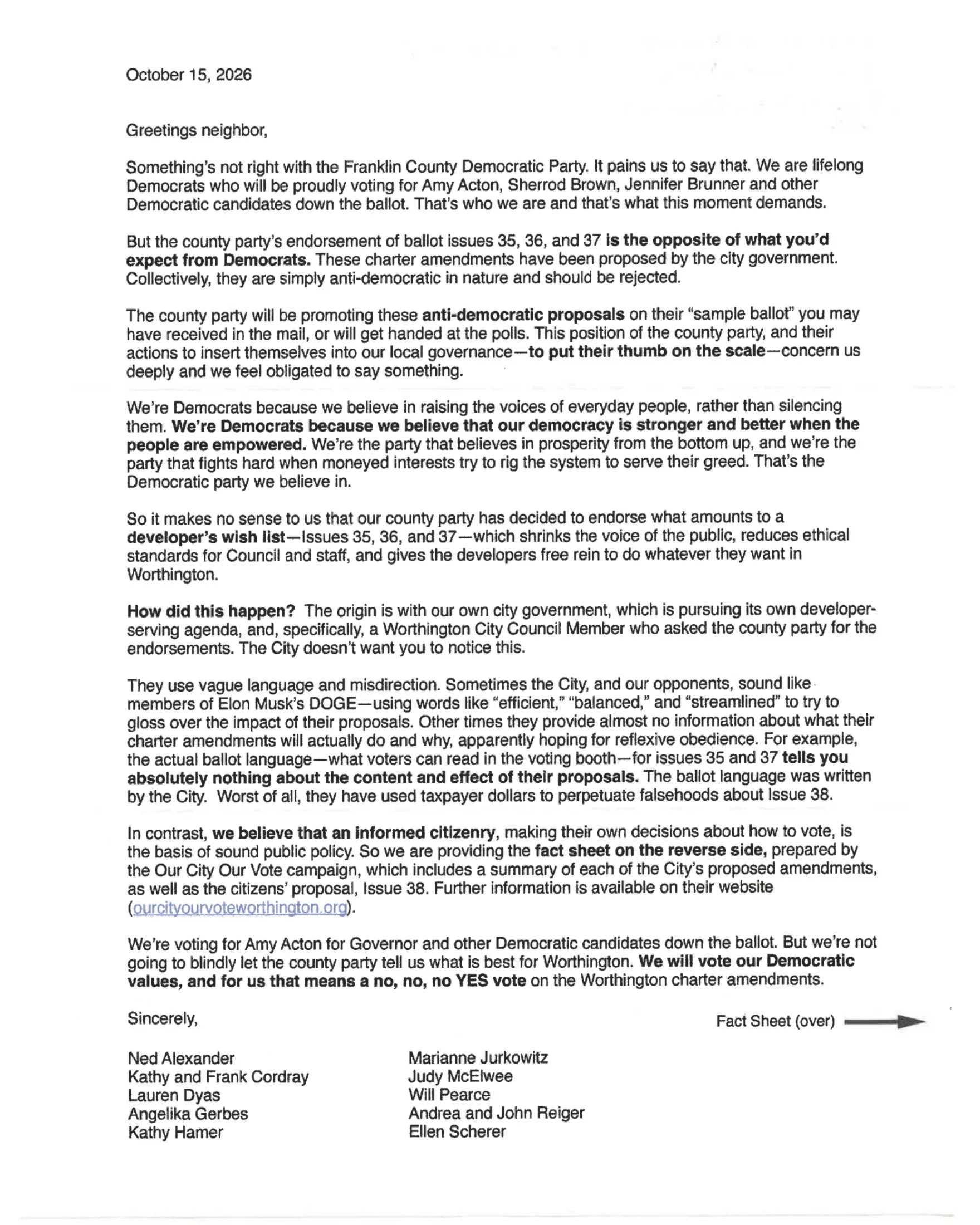
• Claim: The county party’s endorsement of ballot issues 35, 36, and 37 is the opposite of what you’d expect from Democrats... Collectively, they are simply anti-democratic in nature and should be rejected.
• Response: Political values can reasonably lead people to different conclusions about local governance. The Franklin County Democratic Party has endorsed Issues 35, 36 and 37 and has also supported efforts to increase and expand access to housing. More accessible referendum requirements can create additional uncertainty for housing and other development proposals. Issues 35 and 36 do not eliminate the right of referendum. Characterizing them as “anti-democratic” overlooks that they preserve that right while seeking a workable balance between public participation and the ability of elected representatives to govern effectively.
DOGE Comparison
• Claim: Sometimes the City, and our opponents, sound like members of Elon Musk’s DOGE, using words like “efficient,” “balanced,” and “streamlined” to try to gloss over the impact of their proposals.
• Response: The comparison to DOGE mischaracterizes the purpose of these changes. Issue 37 is not about eliminating the public process or simply cutting costs. It is about making the development review process more practical and understandable for the City, residents and businesses alike. Consolidating three boards can reduce the number of separate meetings residents and applicants may need to attend, make a complicated process easier to navigate and help everyone participate in the same process with the same information. Public participation remains part of that process.
Ethics Standards
• Claim: Issues 35, 36 and 37 “reduce ethical standards for Council and staff.”
• Response: Issue 37 does not eliminate the requirement that City officials and employees comply with Ohio ethics and election laws. It literally relocates that requirement within the Charter. The amendment also allows limited exceptions to the prohibition on contracts with City officials or employees, but only when authorized by Council and permitted under Ohio ethics law, with an affected Council member prohibited from participating in the decision.
Ballot Language and Transparency
• Claim: The ballot language for Issues 35 and 37 tells voters “absolutely nothing about the content and effect of their proposals.”
• Response: The ballot language is a summary of the proposed Charter amendments, not the only information available to voters. The City has published the proposed amendments, explanations for the recommendations, the Charter Review Commission’s report and a redlined version of the Charter showing the proposed changes, which can be viewed here: https://worthington.org/2469/Proposed-Charter-Amendments.
Closing Perspective
Comparisons to DOGE and characterizations such as “anti-democratic” or a “developer’s wish list” shift the discussion away from what the proposed Charter amendments actually change. Democracy includes protecting the ability of citizens to challenge government decisions, but it also depends on the ability of elected representatives to govern and carry out decisions supported through the democratic process. When a relatively small number of people can repeatedly delay decisions affecting the broader community, that balance can be disrupted. A more constructive discussion should focus on the actual language of the amendments, their practical effects and the legitimate considerations on both sides.
OUR CITY OUR VOICE LETTER